

Decoding Louis Vuitton: Tradition, Disruption, and the Pharrell Effect

Louis Vuitton is one of the best-known names in luxury brands. Founded in Paris in 1854 by a trunk maker from the Jura mountains, it has been the most valuable luxury brand in Kantar's BrandZ ranking every year since that ranking began1, with a brand value of about $130 billion in the 2024 edition.2

Quick Summary
Louis Vuitton opened his Paris workshop in 1854 after walking from the Jura to Paris as a teenager. His flat canvas trunks, the tumbler lock and the Damier (1888) and Monogram (1896) canvases were each answers to practical problems and to copying. The house merged with Moët Hennessy to form LVMH in 1987, and Marc Jacobs, Nicolas Ghesquière, Virgil Abloh and Pharrell Williams have since reworked its codes. Kantar BrandZ ranked it the most valuable luxury brand in 2024, at about $130 billion.
The LV Monogram, created in 1896 by the founder's son Georges, is still the house's best-known pattern. Around it the company has grown from luggage into handbags, ready-to-wear, shoes, watches, jewelry, fragrance and even restaurants. This article traces how that happened, from a teenager's walk to Paris to Pharrell Williams's first show on the Pont Neuf, and what the house's history means for anyone trying to tell a real bag from a fake one.
The Storied Legacy of Louis Vuitton
Louis Vuitton's history runs through several generations of the Vuitton family, a 1987 merger that created LVMH, and a string of creative directors brought in from outside the house. The pattern that repeats is a practical invention first, then a design people copy, then a new design to stay ahead of the copies.
From Trunk Maker to Fashion Icon
Louis Vuitton was born on August 4, 1821, in Anchay, a hamlet in the Jura region of eastern France. His father, Xavier, was a farmer and his mother, Coronne Gaillard, a milliner. His mother died when he was 10, and his father remarried. In the spring of 1835, at 13, Louis left home on foot for Paris. The 292-mile trip took him more than two years, and he took odd jobs to feed himself along the way. He arrived in 1837, aged 16, and was taken on as an apprentice by a box maker and packer named Maréchal.3 Louis Vuitton's own history says he stayed with Romain Maréchal for seventeen years, learning the trade and the needs of wealthy travelers.4
Box making and packing was a respected trade in 19th-century Paris: a box maker built each case to fit the goods it carried and personally loaded and unloaded it. After Louis-Napoléon became Emperor Napoléon III in 1852, his wife, Empress Eugénie, hired Vuitton as her personal box maker and packer and charged him with "packing the most beautiful clothes in an exquisite way."3 The appointment opened the door to an elite clientele that stayed with him for the rest of his life.
In 1854 he met and married Clémence-Émilie Parriaux, then 17. His great-grandson Henry-Louis Vuitton later recounted: "In the blink of an eye he exchanged the cloth frock and hobnailed shoes of a worker for the courting outfit of the day. The transformation was spectacular, but it required all the know-how of the store's department manager since Louis' shoulders were much larger than those of Parisian bureaucrats."3 A few months after the wedding he opened his own workshop. The sign outside read: "Securely packs the most fragile objects. Specializing in packing fashions."3 Louis Vuitton's history places the first store at 4 Rue Neuve-des-Capucines, near Place Vendôme, with his trunks made in a workshop on Rue du Rocher.4
His first big idea was structural. Trunks of the time were covered in leather, which smelled, and had domed lids so rain would run off, which made them hard to stack. Vuitton covered his trunks in a glued-on grey canvas, first called "gris ordinaire" and later known as Trianon Grey.5 Biography.com dates his first rectangular grey-canvas trunk to 1858 and describes it as the start of modern luggage.3 Louis Vuitton's own account says he redesigned the structure with a flat lid rimmed in iron, beech slats and a lightweight poplar frame, and patented "a packing and travel trunk" in 1867 under patent No. 74557, protecting the design for 15 years.5
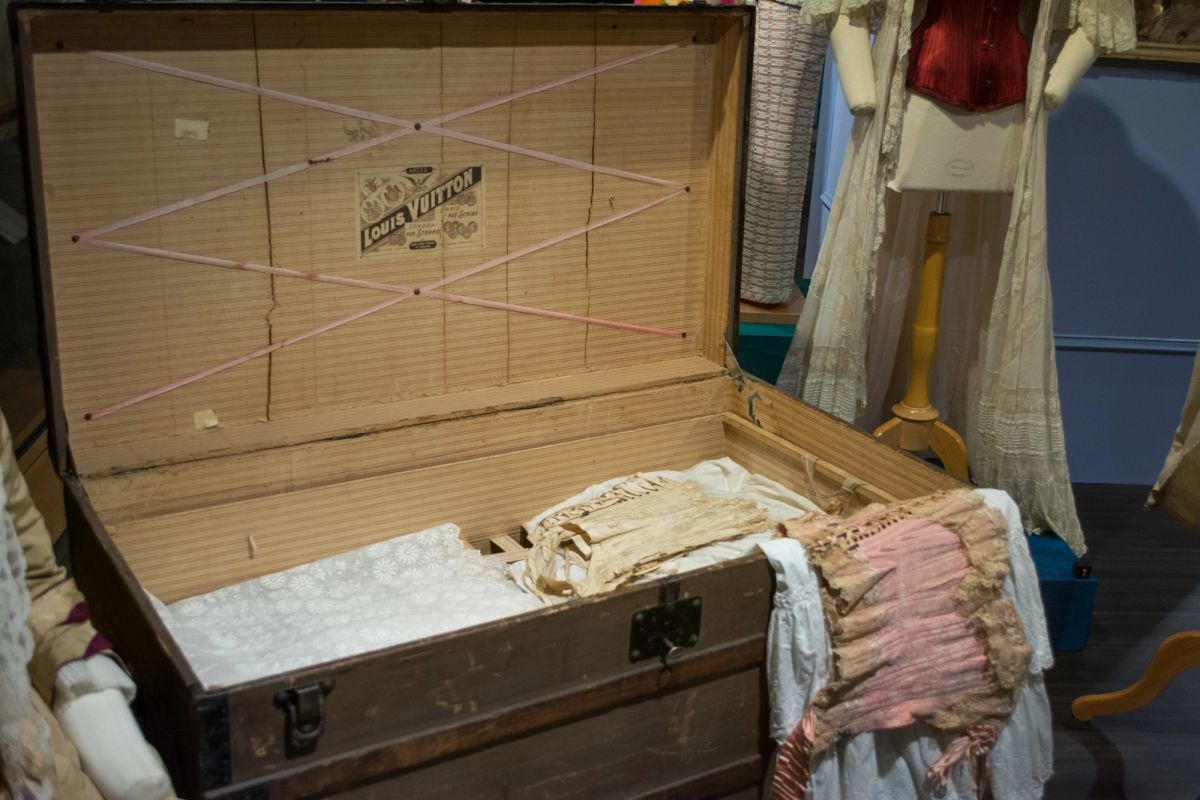
Flat, lighter trunks stacked neatly on trains and steamships, and demand grew.3 In 1859 Louis and his wife bought a 1,080-square-meter plot in Asnières-sur-Seine, outside Paris. The town had a new railway line to the capital, and the Seine let him bring in the poplar wood used for trunk frames.4 Orders came from French royalty and from abroad, including Isma'il Pasha, the Khedive of Egypt.3
The Franco-Prussian War interrupted the business in 1870. When the siege of Paris ended on January 28, 1871, Vuitton returned to Asnières to find the village in ruins, his staff dispersed, his equipment stolen and his shop destroyed. Within months he had opened a new shop at 1 Rue Scribe, a street that was home to the Jockey Club and had a more aristocratic feel than his earlier address.3
The Exhibitions That Built a Reputation
Louis Vuitton used the great international exhibitions of the 19th century as his showroom, and he registered or patented each new product before he displayed it. Over his life he took part in six world expos in Paris, Le Havre and London.5
The first was the 1867 Exposition Universelle in Paris, where he exhibited in Class 38, "Travel and Camping Articles." To afford it, he borrowed 7,000 francs from his cousin Laurent and mortgaged his only asset, the Asnières property. His two-meter display window held trunks filled with fashionable items, and he won a bronze medal for the "packing and travel trunk" he had patented that year.5
In 1868, at the Exposition Maritime Internationale in Le Havre, he showed an airtight, watertight zinc trunk designed for travel "mainly to India and Africa" and won a silver medal. In 1885 he opened a store in London and took part in the International Inventions Exhibition in South Kensington, where his new bed trunk won the only prize in its category.5
The peak came at the 1889 Exposition Universelle in Paris, which drew 32 million visitors to the stands of 61,722 exhibitors beneath Gustave Eiffel's new tower. Louis, then 68, sat on the installation committee for travel and camping items. His 20-square-meter stand occupied one of the nine central platforms in his class, and he was awarded a gold medal, the highest honor for travel items. When the organizers held a nationwide raffle to pay for workers' delegations, he donated two handbags.5
His last exhibition was The French Exhibition at Earl's Court in London in 1890, where he served as a judge and received a hors concours medal.5
The house's own summary of Louis's career lists three guiding principles: improvement and mastery of his savoir-faire, the ceaseless search for new products, and complete customer satisfaction. By the time of his death it had also made him, in its words, "a fierce defender of his distinctive brand, which he protected with patents and trademarks."5
The Iconic Monogram: Birth of a Symbol
Success brought copies, and the house's patterns were its answer. When the Trianon Grey canvas was imitated, Louis introduced a red-and-beige striped canvas in 1872, then a brown-and-beige stripe in 1876, and filed to protect the designs in 1877.4 Some striped canvases were stamped "Déposé," the equivalent of a trademark symbol, but the stripes were copied too.5
In 1888 the house filed two new designs, a "caned" canvas and a chequered canvas that became the Damier. The Damier carried the words "Marque L. Vuitton Déposée" in its squares.5 Eight years later Georges answered the next wave of copies with the Monogram, described in detail below.
Expansion Under Family Leadership
Georges Vuitton was born in 1857 and apprenticed at the Asnières workshops from the age of 16. By 1880 he was running the Rue Scribe store, and father and son added a wing for leather goods at Asnières that year.4 Georges, who had been educated in English on Jersey, pushed the house abroad: the London store opened on Oxford Street in 1885 and moved to New Bond Street in 1900, an address the house still uses.4
Father and son also kept inventing. Louis added the wardrobe trunk in 1875, a vertical trunk that opened like a closet so clothes could hang during a voyage.4 In 1885 Georges patented a footlocker with a removable camp bed, which explorers soon sought out, and the pair patented "a kind of hermetically sealed trunk."5
Security was the next problem. The house began using a multiple tumbler lock in 1887, and Georges filed the patent for it, as a "lock for travel and camping articles," on September 19, 1889. The lock was sold as unpickable, and each customer had a key of their own. Because the work needed specialist precision, the Vuittons hired the locksmiths Fouchet et Delachanal to make it and the patent engineers Marillier & Robelet to file it.5 In October 1891, a few months before his death, Louis signed his last patent, for the use of aluminium in travel articles, which was lighter and sturdier than zinc or copper.5
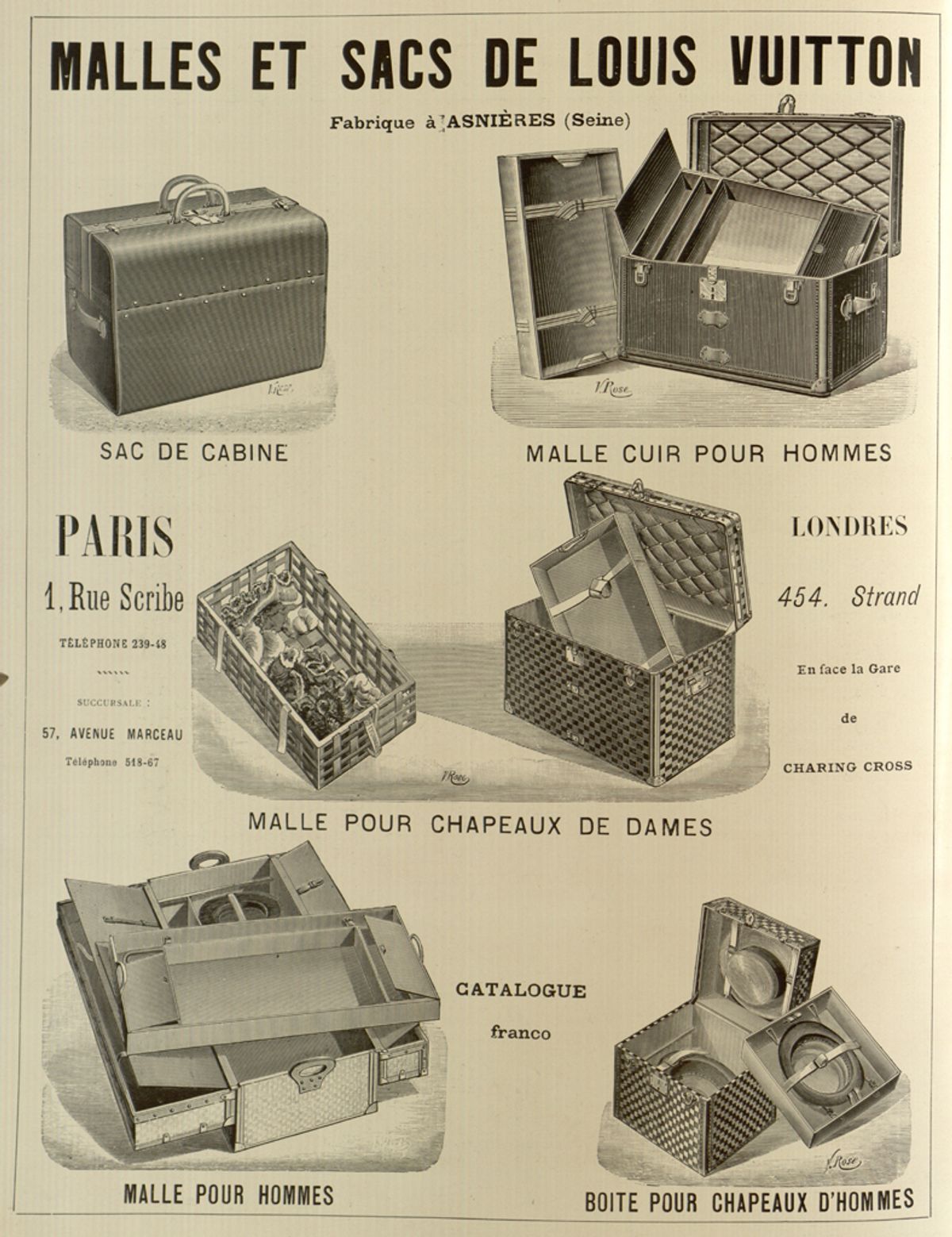
Louis Vuitton died on February 27, 1892, at 70.3 Georges took the house international. After a trip to the United States in 1893, he had Louis Vuitton trunks on sale at John Wanamaker in New York and Philadelphia by 1898.4 An advertisement from that year lists the factory at Asnières, the Paris store at 1 Rue Scribe and a London address on the Strand.
Travel was changing again. Around 1901 the house created the Steamer Bag, a soft, foldable laundry bag that fit in the bottom of a wardrobe trunk on transatlantic crossings. Its sales registers mention Pegamoid, a coated, washable canvas, from 1900, and in 1903 the house named it "Vuittonite," a lightweight material for automobile luggage that could be colored to match a car's body.4
The third generation arrived with Georges's son Gaston-Louis, born in Asnières in 1883, a collector and bibliophile who favored lighter, more flexible materials.4 Under his influence the house trademarked its LV circle logo in 1908, entered horology with a Star Clock in 1910 and equipped the Motobloc automobile for the New York to Paris race.4 Around 1910 it sent small bouquets to loyal clients in a Monogram planter trunk with a zinc liner, which could be reused once the flowers faded, perhaps as a jewelry box.4
In 1914 the house opened the "Vuitton Building" at 70 Avenue des Champs-Élysées, whose window displays Gaston-Louis designed. It remained the Paris address until 1954.4 In 1916 the opera singer Marthe Chenal ordered a pigskin case with a drop front; the model was registered under her name in 1925 and shown that year at the International Exhibition of Modern Decorative and Industrial Arts, alongside a shoe trunk secretary with thirty soft-lined compartments.4 In 1927 the house launched its first perfume, Heures d'Absence, named after the family's country home.4
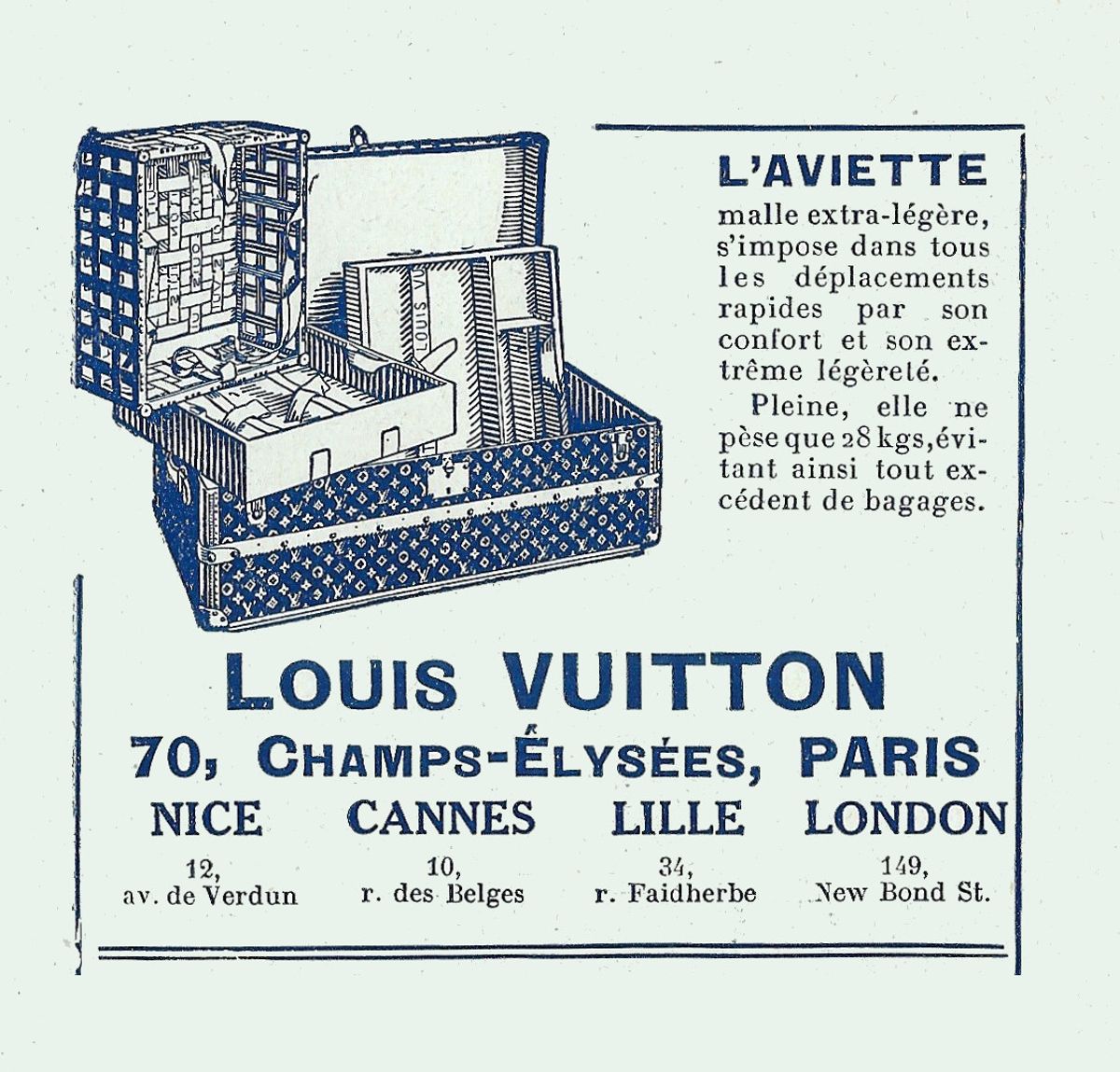
The house also designed for individual clients. For the conductor Leopold Stokowski it created a secretary desk trunk with shelves, drawers, space for a typewriter and a fold-out table, and Gaston-Louis named the model after him.4 When a champagne house asked for a strong bag that could carry five bottles, Gaston-Louis designed the Noé.4 A 1925 advertisement shows the Monogram at work on L'Aviette, sold as an extra-light trunk that weighed only 28 kilograms when full.
The next generation solved a technical limit. The Monogram canvas suited rigid luggage but was too stiff for soft bags, so in the late 1950s Claude-Louis Vuitton developed a new coating process that made it flexible, which opened the way for Monogram handbags.4
The LVMH Era: Global Luxury Expansion
International growth accelerated in the late 20th century. Louis Vuitton made its official debut in Japan in 1978 with franchise stores in Tokyo and Osaka, and opened its first directly operated store there in 1981, on Namiki-dori in the Ginza district.4
In 1987 Louis Vuitton merged with Moët Hennessy to form LVMH. At the time the group had 10 houses, 12,000 employees and sales of 3 billion euros. Bernard Arnault has led the group since 1989.6
The biggest change for the brand came a decade later. In 1997 Louis Vuitton appointed Marc Jacobs as artistic director of its women's and men's collections, with a brief to expand into ready-to-wear and accessories. He stayed for sixteen years.4 In 1998 the house returned to the Champs-Élysées and began building a publishing arm that now counts nearly one hundred titles across its City Guide, Travel Book and Fashion Eye series.4 It entered watchmaking with the Tambour in 2002, launched its first fine jewelry collection in 2004, and in 2006 opened the Espaces Louis Vuitton, permanent contemporary art venues in Paris and other cities.4
Under LVMH the house also opened the Fondation Louis Vuitton, a contemporary art museum designed by Frank Gehry in the Bois de Boulogne, which opened to the public in 2014.6 LVMH was a premium partner of the Paris 2024 Olympic and Paralympic Games6, and Louis Vuitton made the trunks for the medals and torches.4
Manufacturing Excellence and Craftsmanship
Asnières is still the center of the house's craft story. The site was chosen in 1859 for its rail link and its access to poplar wood by river, and the leather goods wing followed in 1880.4 The bed trunk Georges patented in 1885 is still made by special order in the Asnières workshops5, and in 2024 the house reissued it in three editions, including versions by Nicolas Ghesquière and Pharrell Williams.4
Special-order trunks show how far the original idea of a case built for its contents has been pushed. The house's own list includes the 1000 Cigars Trunk of 1997, with a varnished cedar interior; watch cases descended from a 1950s "Boîte à Tout"; the Malle Coiffeuse of 2018, which opens in three sections with trays, drawers and a folding stool; and the Sneaker Trunk of 2019, with fourteen transparent drawers and two built-in mirrors.4
The same logic runs back to the house's first decades. During the 1870s the workshops replaced metal trim with leather for better shock absorption, lined lids with padding and ribbon to protect fragile items, and fitted trunks with compartments.5
Cultural Impact and Celebrity Association
Louis Vuitton's client list has always been part of its story, from Empress Eugénie and the Khedive of Egypt3 to Marthe Chenal and Leopold Stokowski.4 In the 20th century the celebrity most tied to the house was Audrey Hepburn. Sotheby's reports that in 1965 she asked for a smaller Speedy to suit her frame, which led to the 25 cm size7, and Pharrell Williams repeated the story in 2023: "The Speedy was always a men's canvas bag until they made a smaller version for Audrey Hepburn in 1965."8
Sport has been part of the image since 1983, when the house hosted the challenger trials for the America's Cup and made a trunk for the trophy.4 Its first Trophy Trunk, in blue Epi leather, followed in 1988, then a red Epi trunk for the Louis Vuitton Cup in 1992, under the tagline "Victory travels in Louis Vuitton."4
Film has used the brand's travel heritage too. For Wes Anderson's film "The Darjeeling Limited," Anderson and Marc Jacobs studied the house archives to design a set of calf-leather luggage used in the story, decorated with the initials J.L.W. and giraffe, rhinoceros, antelope and palm tree motifs. Jacobs also designed the brothers' suits and blue leather shoes, and the luggage was later auctioned, with proceeds going to the Rawal Mallinathji Foundation.9
The house has also reached into games. In 2016 it partnered with Final Fantasy, featuring the heroine Lightning in a campaign with a capsule by Nicolas Ghesquière, and in 2019 it designed skins for the League of Legends character Qiyana along with a trophy trunk.4
Innovation While Honoring Tradition
Many of the house's modern signatures borrow from its archive. Epi leather, introduced in 1985, draws on 1920s grained leathers including a 1926 Maharajah tea-case; it is drum-dyed, embossed and scratch-resistant.4 The Dauphine, reworked by Nicolas Ghesquière for the 2019 Cruise collection, is based on a 1976 model and uses the LV circle clasp trademarked in 1908.4 The Capucines bag of 2013 is named after the first store on Rue Neuve-des-Capucines.4
Ghesquière's Petite Malle, first shown at his debut women's show for Fall-Winter 2014, took its inspiration from the trunks of the banker and philanthropist Albert Kahn, and the Side Trunk shown at the Cruise 2023 show reinterpreted it.4 Virgil Abloh's first collection, for Spring-Summer 2019, turned the rigid trunk into a soft bag that could be worn over the shoulder or carried as a clutch.4
Innovation has also meant new categories. The Objets Nomades furniture and design collection launched in 2012 with pieces by designers such as the Campana Brothers and is shown at Milan Design Week and Art Basel Miami.4 In 2020 the house opened its first restaurant, at Maison Osaka Midosuji, with chef Yosuke Suga.4
Exclusive Collections and Limited Editions
The house dates its first artistic collaborations to 1910. The modern run began in 2001, when Stephen Sprouse reimagined the Monogram canvas, and has since included Takashi Murakami, Richard Prince, Yayoi Kusama and Jeff Koons.4
Murakami's Monogram Multicolore debuted in 2003 and became one of the house's longest-running collaborations. In July 2015 Hypebeast reported that the line was being discontinued, quoting a store associate at Louis Vuitton's Saks Fifth Avenue location in New York: "The collection is said to be leaving stores at the end of July, forever." Louis Vuitton's representatives said only that the brand preferred to "look forward." Hypebeast reported that the one artist line set to continue was Stephen Sprouse's collection, due that fall in new colors.10
The most talked-about limited collaboration came from the men's side. In January 2017 Kim Jones, then men's artistic director, revealed a collaboration with the New York skate brand Supreme at a show in a transparent tent in the Palais-Royal gardens, attended by David Beckham, Kate Moss and James Marsden. Co-branded pieces ranged from a red fanny pack to a denim jacquard baseball shirt, and the collection was due in stores on July 17.11 Jones said he had been inspired by New York art stars of the early 1980s such as Jean-Michel Basquiat, Julian Schnabel, Keith Haring and Andy Warhol. "The idea is people that wore very luxurious clothes but in a very louche way," he told WWD. "It's sort of Ivy League gone relaxed." For fans with money to spare, he also produced a canvas and Perspex case holding a Technics turntable, reasoning that his DJ friends were returning to vinyl.11
Pharrell Williams was himself an early collaborator. WWD reports that he co-designed eyewear for Vuitton in 2004 and a jewelry collection in 200812, while CNN dates the sunglasses, made with Marc Jacobs and the Japanese designer Nigo, to 2003.8
Preservation of Heritage and Archives
Louis Vuitton treats its past as working material. Its account of Louis's inventions draws on patent filings, sketches and catalogues held in the Louis Vuitton Collection, including an 1892 catalogue that laid out every product line and a sales catalogue listing every medal the house won between 1867 and 1890.5
The house has taken part in and organized heritage exhibitions since the late 19th century. Recent examples include "Volez, Voguez, Voyagez" in 2015, "LV Dream" in 2022 and "Visionary Journeys" in 2024.4
The archive keeps feeding the product line. The 2024 reissue of the 1885 bed trunk, the Side Trunk's debt to the Petite Malle and the Dauphine's 1976 source all come from records the house has kept for more than a century.4
Future Directions While Honoring the Past
By early 2025 the house's direction rested on two designers. Nicolas Ghesquière marked ten years as creative director for women's collections with his Fall-Winter 2024 show on March 5, 2024, in the Cour Carrée of the Louvre, the same place he had shown his first collection exactly ten years earlier.13 Pharrell Williams had led menswear since February 2023.14
The house had also set public environmental targets. WWD reported in 2023 that Louis Vuitton aimed, by 2025, to have one-third of its product categories (leather goods, small leather goods, luggage, shoes and perfume) use an eco-design process that includes a life-cycle assessment, and had climate objectives for 2030 including a 55% reduction in greenhouse-gas emissions.12
Louis Vuitton's Iconic Monogram and Design Elements
Almost every Louis Vuitton pattern began as a response to counterfeiting. The house moved from grey canvas to stripes, from stripes to the Damier, and from the Damier to the Monogram, each time because the previous design was being copied.4
The LV Monogram Canvas
When the Damier canvas was copied too, Georges designed a new pattern in tribute to his father, who had died in 1892. It combined the initials L.V. with three floral motifs, part botanical and part geometric, and drew on Art Nouveau, Japonism and Gothic heraldry. It was introduced in 1896 as the L.V. canvas and has been called the Monogram canvas since 1986.4
The pattern works as both decoration and proof of origin, which is why it survives every change of designer. Its limits were practical: it was made for rigid luggage and needed Claude-Louis Vuitton's flexible coating in the late 1950s before it could be used on soft bags.4
That construction still shapes the bags. Sotheby's notes that the Speedy is cut from a single continuous piece of canvas, so the Monogram appears upside down on one side.7 Artists have reworked the pattern many times, from Stephen Sprouse in 20014 to Murakami's multicolored version in 2003.10
Damier and Other Signature Patterns
The Damier, a checkerboard in shades of brown, was filed in 1888. It was the first Louis Vuitton canvas to carry the name on the outside of a trunk, with "Marque L. Vuitton Déposée" printed in one of the squares.4 The pattern stayed in use until the late 1910s and was brought back for leather goods in 1996.5
The Damier and the Monogram both served as a brand identity and as protection against copies. Epi leather, introduced in 1985, added a third signature.4
The Damier has kept changing hands. At Pharrell Williams's first show in June 2023, the Pont Neuf was laid with a continuous strip of the pattern, and a pixelated version called "Damoflage" ran through overcoats, suits, trunks and oversized Speedy bags.8 LVMH described the collection as drawing on stylized Ls and Vs and on pieces stamped with the "Marque L. Vuitton Déposée" logo pulled from the archives.15
Flagship Products in the Louis Vuitton Collection
The best-known Louis Vuitton products are soft bags that grew out of the house's luggage, alongside a smaller number of categories that trade on the same codes.
Handbags and Leather Goods
The Keepall was introduced in the 1930s under the name Tientout, as a soft travel bag in canvas and leather with a rounded shape and Toron handles.4 The Speedy followed from it. Sotheby's dates its launch to 1930 under the name "Express," initially in a single 30 cm size, with 35 and 40 cm versions soon after, and says it was first made in plain canvas before moving to Monogram.7 Louis Vuitton's own timeline says it was reworked as a Monogram canvas handbag in 1959.4
Sotheby's traces later Speedy variations, including the Speedy Bandoulière of 2011, which added a detachable shoulder strap, and the Speedy Cube of 2013, and lists artists who have reworked the bag, among them Stephen Sprouse, Urs Fischer, Richard Prince, Yayoi Kusama and Sofia Coppola.7 At Pharrell Williams's 2023 debut the bag returned in calf leather in cherry red, sunshine yellow and green, in larger and softer sizes.8
The Alma's origin is told two ways. Sotheby's says Gabrielle Chanel asked Vuitton for a dome-shaped day bag in 1925 and agreed in 1934 to let it be produced for the public.7 Louis Vuitton's own history says the model began as the Squire Bag in 1934, was renamed Champs-Élysées and then Marceau, became the Alma in 1992 and gained a BB size in 2010.4
Other house signatures include the Noé, dressed in Monogram canvas in 1959; the Sac Plat, created as a beach bag in 1968; the Neverfull of 2007; the Twist of 2015; the OnTheGo tote of 2019; and the Coussin, introduced in the Spring-Summer 2021 collection.4 For men, the Christopher backpack debuted in the Fall-Winter 2004-05 show.4
Ready-to-Wear Fashion Lines
Ready-to-wear arrived with Marc Jacobs in 1997, when he was hired to lead the women's and men's collections and expand into clothing and accessories.4 Since then the men's and women's lines have been led separately.
Menswear has been the more headline-grabbing. Kim Jones led it when he staged the Supreme collection in 2017, and he said at the time that pairing very luxurious items with Supreme cardholders and handkerchiefs was deliberate: "The fact that it crosses a lot of different generations is important for Vuitton, because we have such a vast demographic."11 Virgil Abloh took over in 201816, and Pharrell Williams in 2023.14
Womenswear has been shaped by Nicolas Ghesquière since his first collection in March 2014, shown in the Cour Carrée of the Louvre, where he returned to mark ten years in 2024.13
Additional Products
Beyond bags and clothing, the house sells watches, jewelry, fragrance, furniture and books. Its watchmaking began in 2002 with the Tambour, whose drum-shaped case, brown dial and yellow hands refer to the thread used in leatherwork.4 Its first fine jewelry collection followed in 2004.4
Fragrance goes back to Heures d'Absence in 1927; the name returned in 2020 for a new women's scent, and Jacques Cavallier Belletrud has been master perfumer since 2012, working from Grasse.4 The Objets Nomades design collection dates to 2012, and the publishing program runs to nearly one hundred titles.4
The Evolution of Louis Vuitton Under Different Creative Directors
Since 1997 Louis Vuitton has been shaped by designers hired from outside the family, each given room to rework the house codes.
Marc Jacobs' Transformative Era
Marc Jacobs arrived in 1997 to build ready-to-wear and accessories and stayed sixteen years. His shows became major events, and his artist collaborations with Stephen Sprouse, Takashi Murakami and Richard Prince put the Monogram in front of a new audience.4 Murakami's Multicolore line, launched in 2003, outlasted Jacobs's tenure and was discontinued in 2015.10
Jacobs also carried the house into film, working with Wes Anderson on the luggage, suits and shoes for "The Darjeeling Limited."9
Nicolas Ghesquière and the Women's Collections
Nicolas Ghesquière is artistic director of the women's collections.4 He presented his first collection for Louis Vuitton in the Cour Carrée of the Louvre on March 5, 2014, and marked ten years in the role at the same venue on March 5, 2024. LVMH described that anniversary show, lit by luminous celestial globes, as retracing his decade at the house while exploring new directions, with architectural shoulders, reflective materials, soft leathers, masked eyes and gloved hands.13
His tenure produced several of the house's modern bags, including the Petite Malle of 2014 and the reworked Dauphine of 2019, as well as the 2016 Final Fantasy campaign.4
Virgil Abloh's Revolutionary Vision
Virgil Abloh became men's artistic director in March 2018.16 He was the first Black artistic director at Louis Vuitton.14 Born in Rockford, Illinois, in 1980, he earned a degree in civil engineering from the University of Wisconsin-Madison and a master's in architecture from the Illinois Institute of Technology. He founded Off-White, which began in 2012 as an artwork called "PYREX VISION," was a finalist for the LVMH Prize in 2015, and had a major exhibition at the Museum of Contemporary Art Chicago in 2019.16
At Louis Vuitton he brought streetwear influences to the men's collections.4 The Associated Press, as cited by NPR, described him growing the role from "designer" to "curator," and Business of Fashion wrote that "He reinvented the role of a creative director, injecting it with hip-hop's penchant for remixing, skateboarding's sense of community and a desire for social progress."14
Abloh died of cancer on November 28, 202116, at the age of 41.14 The last collection he designed was unveiled at a show with a soundtrack by Tyler, the Creator, played by an orchestra conducted by Gustavo Dudamel. Bernard Arnault later said of it: "It was a performance, and that's the spirit of Louis Vuitton. It's much more than a fashion brand. It's a cultural brand with a global audience."12
Louis Vuitton's Position in Luxury Fashion Today
The men's role stayed empty for more than a year after Abloh's death, while the house staged men's shows with live performances by artists including Tyler, the Creator, Kendrick Lamar and Rosalía. In January 2023 it brought in KidSuper founder Colm Dillane as guest designer.12 On February 14, 2023, Louis Vuitton named Pharrell Williams as its Men's Creative Director14, effective immediately.12
The appointment was the first major decision of Pietro Beccari, who had become chairman and CEO of Louis Vuitton on February 1 after moving from Dior.12 Beccari said: "I am glad to welcome Pharrell back home, after our collaborations in 2004 and 2008 for Louis Vuitton, as our new Men's Creative Director."14 WWD reported, citing sources, that Williams was expected to spend at least a third of his time at the house.12
Williams arrived with a long résumé outside fashion design. NPR described him as a 13-time Grammy winner and two-time Oscar nominee who co-founded the streetwear label Billionaire Boys Club in 2003 with the Japanese designer Nigo, later artistic director of LVMH's Kenzo, and who had worked with Moncler, Adidas Originals and Tiffany & Company.14 WWD added his production work for artists including Beyoncé, Jay-Z and Rihanna, and his role as creative director of Bionic Yarn, which makes textiles from plastic waste recovered from the ocean.12
Some observers questioned the choice. Industry watchers had expected an emerging designer, with names such as Martine Rose, Grace Wales Bonner and Samuel Ross in circulation.12 NPR reported that some people online criticized the decision to hire a celebrity rather than a younger designer with formal training, quoting one post: "This is a weird appointment."14
Williams showed his first collection on June 20, 2023, on the Pont Neuf in Paris, at sunset, with a full orchestra, the Voices of Fire gospel choir and more than 70 looks. Guests traveled by boat along the Seine to the bridge, which sits at the foot of the LVMH-owned Samaritaine department store.8 LVMH noted that the Pont Neuf was the first stone bridge to span the Seine when it was built in the 16th century, and that staging the show there, next to Louis Vuitton's headquarters, was a nod to the house's attachment to Paris and to travel.15 His show notes paid tribute to "the giant before me," Virgil Abloh, and in a press release he said: "Virgil has always been a brother in spirit." He added: "I can tell you that Virgil and me being here has to say to kids who look like us, 'Oh, I can do anything. I can be anything.'" The collection introduced a logo combining LV with the word "lovers," and the show notes explained: "LVERS is a state of mind: warmth, wellbeing, and welcome-ness."8
The connection between the two designers ran deep. WWD recalled that Abloh told The New York Times in 2020 that Williams had profoundly influenced him in the early 2000s: "The prototype at the time was that you had to be a thug or an athlete or a rapper. And then he came along with a different panache as a producer, an artist, a tastemaker, an individual."12 LVMH described the show as a tribute to creativity and craft15, and it is a clear case of brand storytelling built on a real archive: Georges Vuitton's 1888 Damier, pixelated into camouflage.
Brand Value and Market Presence
WWD describes Louis Vuitton as the world's largest luxury brand. In January 2023 Bernard Arnault said the brand's sales had passed 20 billion euros for the first time in 2022.12
Kantar BrandZ put Louis Vuitton's brand value at $124.8 billion in 2023, up 0.4% from $124.3 billion, making it the most valuable luxury brand for the 18th consecutive year, the only brand in any sector to hold its category lead since the rankings began. In the same report the luxury top 10 fell only 4% in total brand value while the global top 100 fell 20%, which Kantar attributed to luxury brands leveraging their brand equity and pricing power. Dior was the fastest-growing luxury brand that year at 9%, while Hermès rose from No. 27 to No. 19 and Chanel from No. 45 to No. 31 in the overall top 100.1
In the 2024 ranking Louis Vuitton stayed first in luxury at about $130 billion.2 FashionNetwork, reporting on the same ranking, put the figure at $129.8 billion, up 4%, and noted that Louis Vuitton had dropped to 12th place in the overall global ranking, behind brands including Apple, Google, Microsoft, Amazon, Facebook, McDonald's and NVIDIA, with Hermès second in luxury at $93.7 billion.17
Celebrity Endorsements and Collaborations
Louis Vuitton's shows have become celebrity events in their own right. At the Supreme show in 2017, the actor James Marsden said his teenage son was "obsessed with Supreme."11 At Pharrell Williams's 2023 debut, the front row included Rihanna, then the face of the brand's campaign, along with Jay-Z, Beyoncé, Kim Kardashian, Jared Leto, Lenny Kravitz, Naomi Campbell and the brand ambassador Zendaya.8
Williams brought his own collaborators into the collection, including embroidered designs based on the work of the American artist Henry Taylor, and composed music for the show, including "Joy (Unspeakable)" and "Peace Be Still" with the pianist Lang Lang.8 His wider résumé also mattered to the house: WWD noted that his 2017 sneaker collaboration with Chanel generated a waiting list of 120,000 people for 500 pairs.12
Authentication Guide: Spotting Genuine Louis Vuitton Items
Counterfeiting has shaped Louis Vuitton since the 1870s, and it is still the main risk for anyone buying secondhand. The house even played on it: at Pharrell Williams's 2023 show, new Speedy colorways nodded to the counterfeit bags sold on New York's Canal Street. The show notes said the bag "conjures the attitude and hustle mentality of Canal Street in an everyday icon conceived for every walk of life."8 For buyers, two features help establish when and where a modern piece was made.
Locating and Verifying Date Codes
From 1982, Louis Vuitton added codes to its items showing when and where they were made. Early codes were three or four numbers giving the year and month. In the mid to late 1980s two letters were added to identify the factory. From 1990 to 2006 the format was two letters for the factory followed by four numbers, with the first and third giving the month and the second and fourth the year. From 2007 the numbers give the week instead of the month, so SR 3179 means the 37th week of 2019.18
Codes are usually stamped on a leather tab sewn into an interior seam, on the underside of a D-ring tab, or directly on the lining. The tab leather should match the rest of the bag. On Alcantara linings the code is stamped into the microsuede and often fades until it is almost impossible to read, and on wallets it usually sits along a side seam in the billfold or slip pocket.18
The letters match the "Made in" heat stamp under the logo. Fashionphile's list of French factory codes includes AR, SP and SR, Italian codes include BO and CE, Spanish codes include CA and LO, American codes include FC and OS, and Swiss codes include DI and FA. Some prefixes appear under more than one country in that list, so the heat stamp is the tiebreaker. Pieces made before about 1980 have no date code, and the font of a code can be serif or sans-serif depending on the style and production run.18
A correct date code does not prove a bag is real, because many counterfeits copy the format. Authenticators also look at fonts, stamps, symmetry, workmanship and materials.18
Recognizing Modern Authentication Features
As of March 2021, many Louis Vuitton bags and accessories no longer carry a date code or a "Made in" stamp. They contain an embedded microchip instead. Lollipuff, an authentication service, expected Louis Vuitton to keep chip verification in-house, out of easy reach of consumers, and said that makes some newer pieces harder for independent authenticators to assess.19
Lollipuff argued that simple styles without a date code or "Made in" stamp have fewer points to check, which could make them harder to sell and easier to counterfeit convincingly. It said it would refund its authentication fee on newer bags when it could not reach a confident assessment.19
Price Points and Resale Value
Louis Vuitton's prices are part of its positioning, and outside observers point to that power. Kantar's 2023 report credited luxury brands' ability to leverage their brand equity and pricing power for their resilience during the cost-of-living crisis. The report argued that luxury brands "know how to leverage their distinctive assets to drive sales – from accessible cosmetics to iconic handbags," and that their logos "permeate mainstream ideas of quality and success that help them navigate market fluctuations."1
The range is wide. When Kim Jones showed the Supreme collection in 2017, he said made-to-order pieces such as a vicuña trench coat or a shearling-lined crocodile jacket would cost more than $100,000, while the same collection included Supreme cardholders and handkerchiefs.11
A large secondary market sits alongside the stores. Sotheby's sells pre-owned Speedy bags alongside its history of the model7, and resale platforms such as Fashionphile authenticate Louis Vuitton pieces before sale.18 Discontinued lines draw attention: when Murakami's Multicolore left stores in 2015, Hypebeast reported the news from the sales floor.10 The shift to microchips has complicated that market, according to Lollipuff.19 Resale prices depend on condition, rarity and demand at the moment of sale, so any future resale value is uncertain.
Conclusion
Louis Vuitton's history is a sequence of practical fixes that became design codes: flat canvas trunks that stacked, a lock with its own key for each customer, and canvases redesigned each time copies appeared. The house has kept those codes while handing them to outsiders, from Marc Jacobs and his artist collaborations to Virgil Abloh and Pharrell Williams, whose first show put the 1888 Damier on a Paris bridge. The same archive that feeds its runway also gives buyers the tools to check what they are buying.
Frequently Asked Questions
When was Louis Vuitton founded?
Louis Vuitton opened his own box-making and packing workshop in Paris in 1854, after years as an apprentice. The house now belongs to LVMH, formed in 1987, and Kantar BrandZ ranked it the most valuable luxury brand in 2024 with a brand value of about $130 billion.
What is the significance of the LV monogram pattern?
Georges Vuitton created the Monogram in 1896 as a tribute to his father and as a new design after earlier Louis Vuitton canvases had been copied. It combines the initials L.V. with three floral motifs.
How did Louis Vuitton expand beyond trunks?
The house added a leather goods workshop in 1880, launched its first perfume in 1927 and developed soft bags such as the Keepall and Speedy in the 1930s. After Marc Jacobs arrived in 1997 it expanded into ready-to-wear, and it added watches in 2002 and fine jewelry in 2004.
Who were some notable creative directors of Louis Vuitton?
Marc Jacobs led the women's and men's collections from 1997 for sixteen years. Nicolas Ghesquière has designed the women's collections since his first show in March 2014. Virgil Abloh led menswear from March 2018 until his death in November 2021, and Pharrell Williams was named Men's Creative Director in February 2023.
How can I authenticate a Louis Vuitton product?
Check the date code, the "Made in" heat stamp, fonts, stitching and materials together, since counterfeiters often copy date codes correctly. Many items made since March 2021 have an embedded microchip in place of a date code, which consumers cannot easily verify themselves. For an expensive purchase, use a professional authenticator.
How has Louis Vuitton maintained relevance in modern fashion?
It keeps its historic patterns and reworks them through outside designers and collaborators, from Stephen Sprouse and Takashi Murakami to Supreme in 2017 and Pharrell Williams's Damier-covered debut on the Pont Neuf in 2023.
What is the Damier pattern and how does it differ from the Monogram?
The Damier is a brown checkerboard filed in 1888, eight years before the Monogram. It was the first Louis Vuitton canvas to carry the house name on the outside. The Monogram uses the L.V. initials and floral motifs in place of squares.
Sources
- 1
- 2
- 3
- 4
- 5
- 6
- 7
- 8
- 9
- 10
- 11
- 12
- 13
- 14
- 15
- 16
- 17
- 18
- 19

Valencia Jackson is a Communications Director at AMW, where she develops creative strategy and brand positioning for clients ranging from emerging brands to Fortune 500 companies.
Related Resources
Related Articles
The Cartier Formula for Transforming Heritage into Modern Luxury Success
Cartier's brand storytelling strategy has transformed the luxury jewelry house into one of the world's most recognized names in high-end fashion and accessories. The French maison has mastered the art

What Keeps the Lacoste Brand Relevant Across Generations
The iconic crocodile logo that graces millions of polo shirts worldwide belongs to Lacoste, a French luxury brand that's become synonymous with athletic elegance and timeless style. Founded in 1933 by

From Sea to Summit: The Epic 145-Year Story of Helly Hansen's Innovation Legacy
In 1877, Helly Hansen was founded by Norwegian sailor Helly Juell Hansen and his wife, pioneering waterproof maritime apparel through a unique linen treatment. Earning early acclaim, the brand...